> For the complete documentation index, see [llms.txt](https://docs.flatredball.com/gum/llms.txt). Markdown versions of documentation pages are available by appending `.md` to page URLs; this page is available as [Markdown](https://docs.flatredball.com/gum/gum-tool/gum-elements/sprite/texture-address.md).

# Texture Address

## Introduction

The texture address property controls the texture address behavior of a sprite. Specifically it can control whether texture addresses variables are available, and how texture coordinates and sprite size are related.

## Entire Texture

If the texture address property is set to **EntireTexture** then the sprite draws its full image. The sprite does not repeat or render only part of the texture. This renders the entire image.

![Sprite with Texture Address set to EntireTexture](/files/95pjz07vuY3NPWfQYTYu)

## Custom

If the texture address property is set to **Custom** then the top, bottom, left, and right properties can be independently set. This allows a sprite to only render a portion of its source texture.

![Sprite with Texture Address set to Custom](/files/SLpNXNGiiVL7p3wtNB2Q)

Typically a Texture Address of Custom is used in combination with a **Width Units** of **Percent of File Width** and a **Height Units** of **Percent of File Height**. In this case, the size of the sprite depends on the texture coordinates.

When using Custom Texture Address, wrapping is possible. For more information see the [Wrap](#wrap) page.

## DimensionsBased

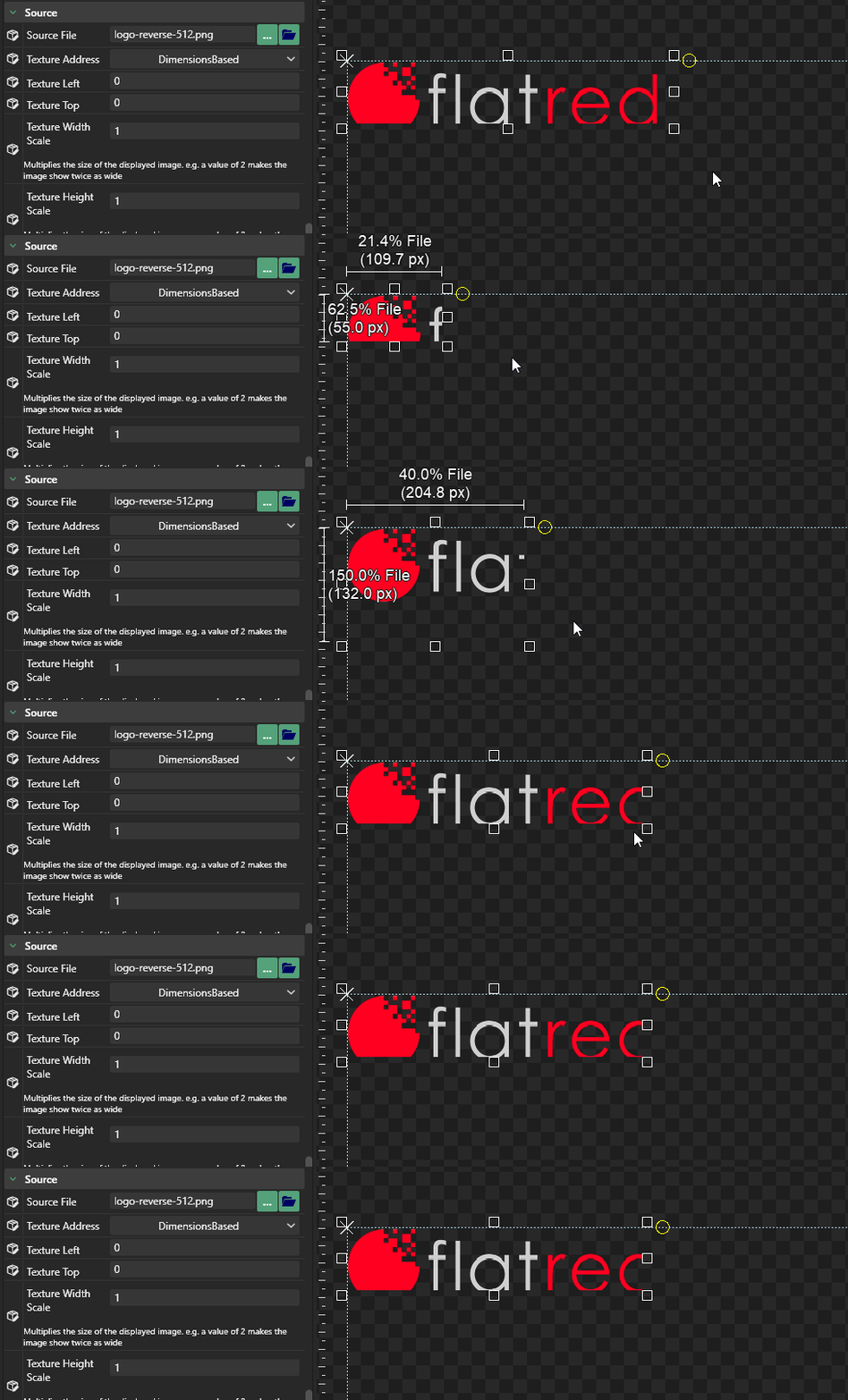
If the **Texture Address** property is set to **DimensionsBased** then the texture coordinates adjusts internally according to the width and the height of the Sprite. In other words, making the sprite larger or smaller does not stretch the image that it is rendering. Instead the image is be clipped, or clamped/wrapped according to the Wrap property.

<figure><img src="/files/6ifDO0dZtsFpZu0m6EnH" alt=""><figcaption><p>Resizing a Sprite with Texture Address set to DimensionsBased</p></figcaption></figure>

When the Texture Address is set to DimensionsBased, then the Texture Width and Texture Height values are replaced by Texture Width Scale and Texture Height Scale. In this mode, the Texture Width and Texture Height values are calculated by multiplying the absolute size of the Sprite by its respective scale values.

When using DimensionsBased Texture Address, wrapping is possible. For more information see the [Wrap](#wrap) page.

#### DimensionsBased Texture Address and Percentage of File Width/Height

If a Sprite uses a **Width Units** of **Percentage of File Width** or a **Height Units** of **Percentage of File Height**, then the Width and Height values represent the size of the sprite relative to the entire source file.

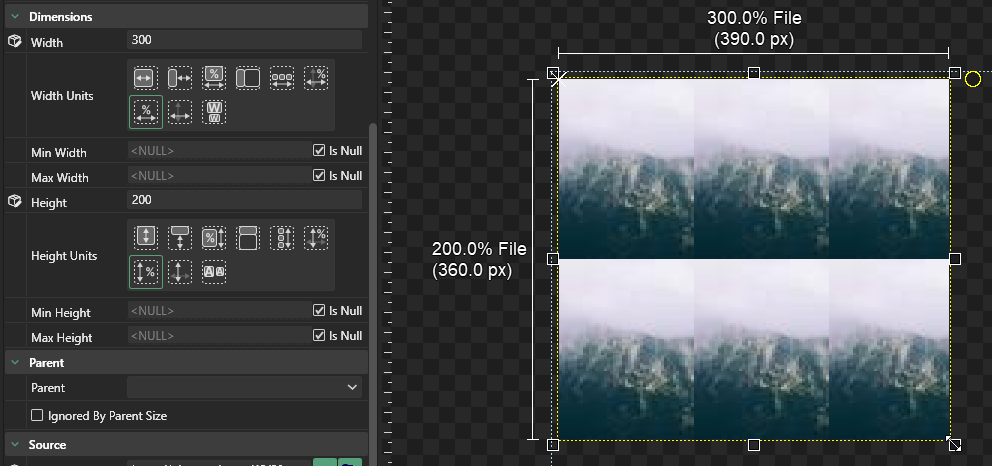
For example, if a Sprite is displaying a source PNG file with a width of 130 pixels and its Width is 300, then the absolute width of the Sprite is 390 (130 \* 300%). If Wrap is checked, then this indicates the number of times that the image repeats on the Sprite.

<figure><img src="/files/xruNwt4QdkNbOCs9f64M" alt=""><figcaption><p>Sprite displaying a PNG with dimensions 130x180 with a Width of 300 and Height of 200</p></figcaption></figure>

#### Texture Width Scale and Texture Height Scale

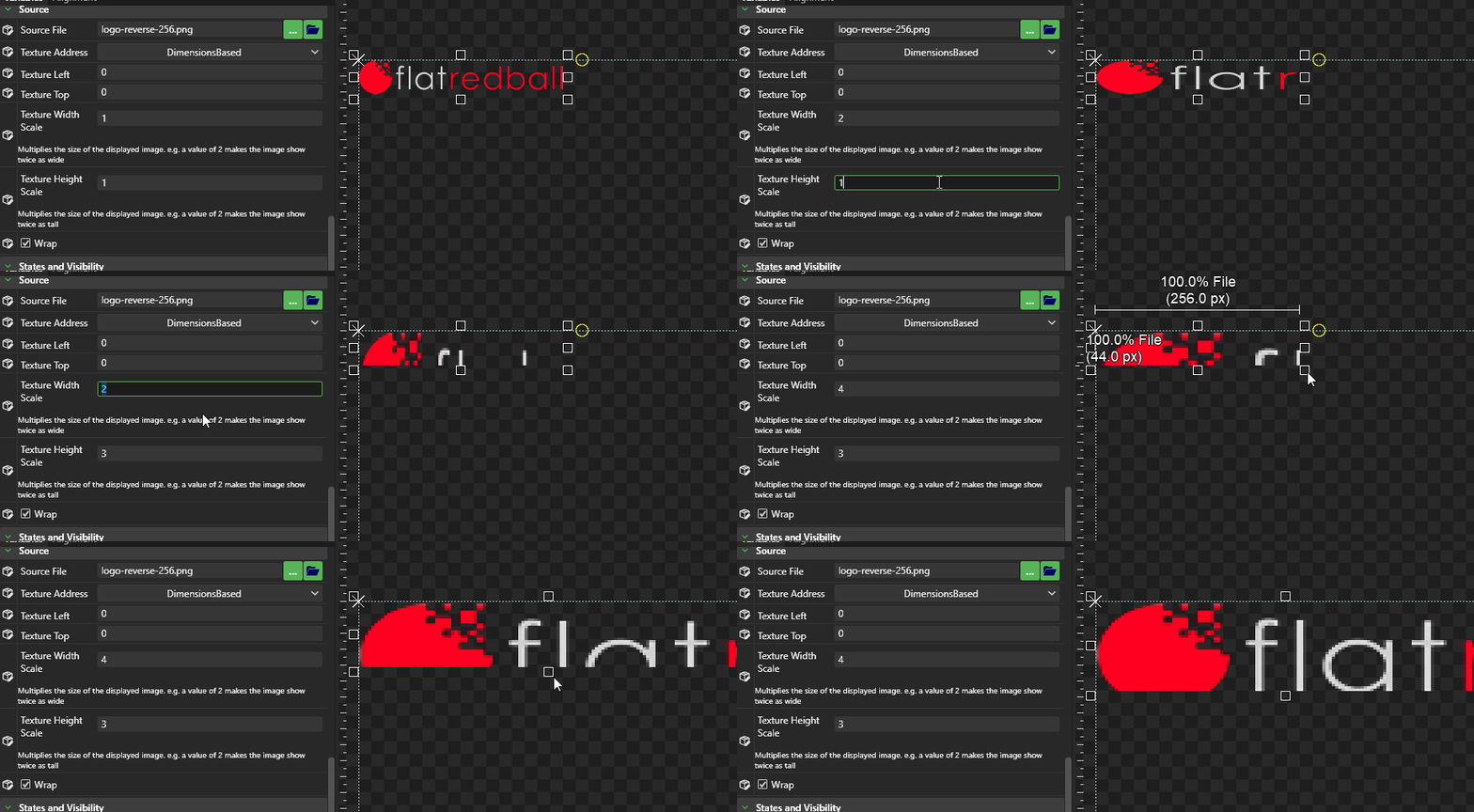
The Texture Width Scale and Texture Height Scale values determine the size of the texture on the Sprite when using DimensionsBased Texture Address. By default this value is 1, which means that the source image displays at its native size.

Increasing this value results in the image displaying larger. For example setting a value of 2 results in the displayed image being twice as large. Scale values for width and height can be set independently.

<figure><img src="/files/QJ3aBLRc84jdiYjaLnwp" alt=""><figcaption><p>Larger scale values increase the displayed size of the texture</p></figcaption></figure>

{% hint style="info" %}
Since a larger value results in the image appearing larger, this means that mathematically a larger scale value results in smaller Texture Width and Texture Height value.
{% endhint %}


---

# Agent Instructions
This documentation is published with GitBook. GitBook is the documentation platform designed so that both humans and AI agents can read, navigate, and reason over technical content effectively. Learn more at gitbook.com.

## Querying This Documentation
If you need additional information that is not directly available in this page, you can query the documentation dynamically by asking a question.

Perform an HTTP GET request on the current page URL with the `ask` query parameter, and the optional `goal` query parameter:

```
GET https://docs.flatredball.com/gum/gum-tool/gum-elements/sprite/texture-address.md?ask=<question>&goal=<endgoal>
```

`ask` is the immediate question: it should be specific, self-contained, and written in natural language.
`goal` is optional and describes the broader end goal you are ultimately trying to accomplish on behalf of the user. GitBook uses it to tailor the answer towards what is most useful for that goal.

The response will contain a direct answer to the question and relevant excerpts and sources from the documentation.

Use this mechanism when the answer is not explicitly present in the current page, you need clarification or additional context, or you want to retrieve related documentation sections.