> For the complete documentation index, see [llms.txt](https://docs.flatredball.com/gum/llms.txt). Markdown versions of documentation pages are available by appending `.md` to page URLs; this page is available as [Markdown](https://docs.flatredball.com/gum/gum-tool/gum-elements/sprite/source-file.md).

# Source File

### Introduction

The Source File property determines the file that is used by the Sprite. Sprite Source Files support the following formats:

* .png files
* .achx files (AnimationChains)
* Images from URLs

<figure><img src="/files/FUuBBSOo60hQmFV831i0" alt=""><figcaption><p>Sprite displaying the FlatRedBall logo</p></figcaption></figure>

If a Sprite has an empty Source File or if it references a missing file, then the missing file texture is displayed.

<figure><img src="/files/fNCp0Wg9raDnl2iWwhOW" alt=""><figcaption><p>Sprite with a missing or emtpy Source File</p></figcaption></figure>

### Setting a PNG Source File

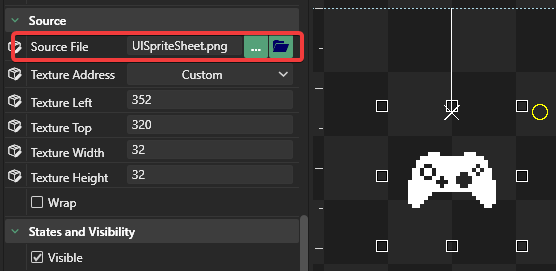
Source File can be set by typing a value or using the **...** button to browser for a file.

All files are added as paths relative to the .gumx project.

<figure><img src="/files/cklp7jxtdvuz6CFLQ66r" alt=""><figcaption><p>Sprite referencing UISpriteSheet.png located in the same folder as the .gumx file</p></figcaption></figure>

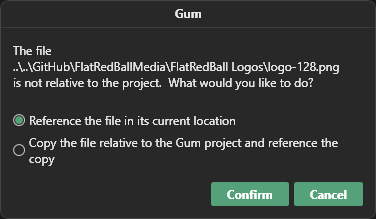
If a file is referenced outside of the .gumx folder, then Gum asks if you would like to copy the file or reference it outside of the current directory. Usually files should be copied to the project folder to keep the entire Gum project portable.

<figure><img src="/files/xzA2UnJAqE9eFGnRe58r" alt=""><figcaption><p>Gum asking whether a file should be copied or referenced in its current location.</p></figcaption></figure>

### ACHX Files

Gum natively supports referencing Animation Chain XML files (.achx) which are created by the FlatRedBall AnimationEditor. For more information on creating .achx files, see the FlatRedBall [AnimationEditor page](https://docs.flatredball.com/flatredball/glue-gluevault-component-pages-animationeditor-plugin).

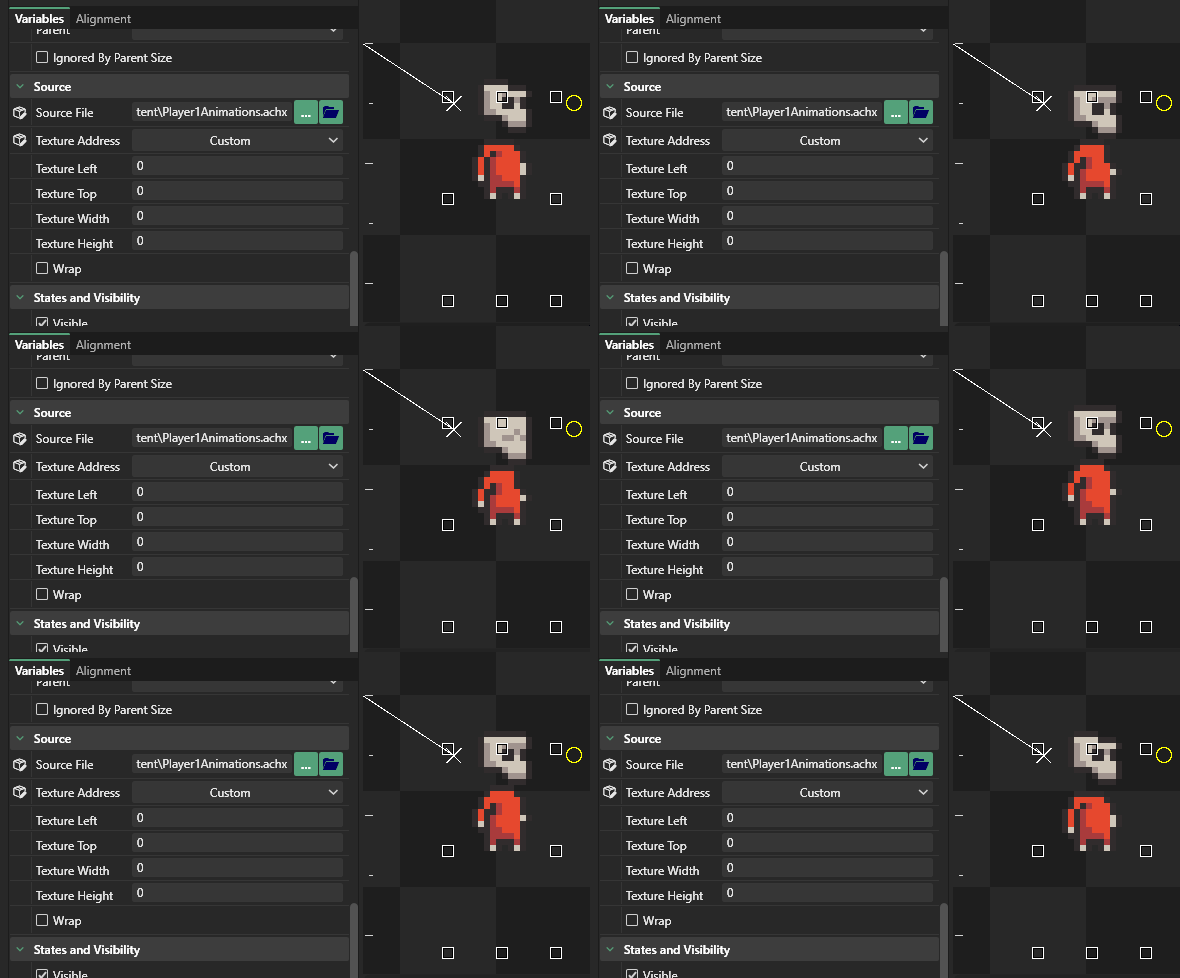
Once you have created an .achx file, you can reference it the same as a .png by entering its name or selecting it with the **...** button.

<figure><img src="/files/eJepVQZ2OmuDK4csVaeJ" alt=""><figcaption><p>Animated sprite referencing an .achx file</p></figcaption></figure>

When referencing an .achx file, be sure to also check the **Animate** checkbox and to select the **Current Chain Name**.

{% hint style="info" %}
.achx files are XML files which reference one or more other PNG files. If you are moving an .achx file be sure to also move the referenced PNG files.
{% endhint %}

#### Per-Frame Offsets and Sprite Origin

Frames in an .achx can carry per-frame `RelativeX` / `RelativeY` offsets, typically authored in the FlatRedBall AnimationEditor to keep visual content (e.g. the bottom of a collapsing object) anchored as the source rectangle changes size from frame to frame.

The AnimationEditor authors these offsets against a **center-anchored** Sprite. When a Sprite in Gum plays back an .achx with non-zero offsets, set both **XOrigin** and **YOrigin** to **Center** so the offsets compensate as intended.

{% hint style="warning" %}
If the Sprite's origin is left at the default (top-left) and its Width/Height units track the source file (such as `PercentageOfSourceFile`), frames that change size will drift — typically the visual will appear to climb or slide as the animation progresses, even though the offsets look correct in the AnimationEditor. The Gum tool will surface a warning in the Errors tab when it detects this combination.
{% endhint %}

### Referencing URLs

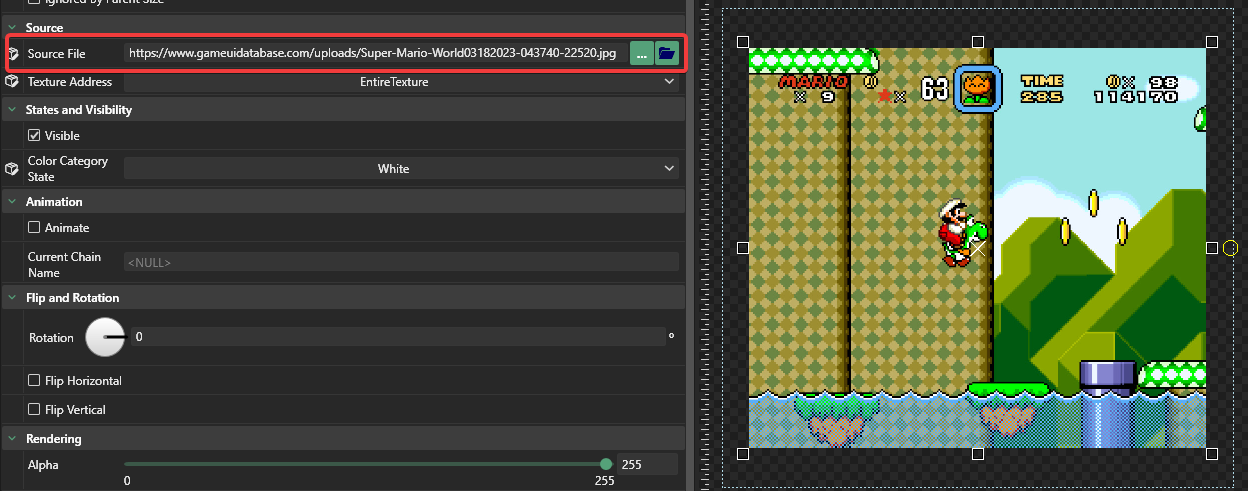
Gum Sprites can also reference URLs. Gum can display images from URLs with standard file extensions such as .png and .jpg

<figure><img src="/files/CtooXLGxGhro8Oevaizm" alt=""><figcaption><p>Gum Sprite referencing an image of Super Mario World from gameuidatabase.com</p></figcaption></figure>

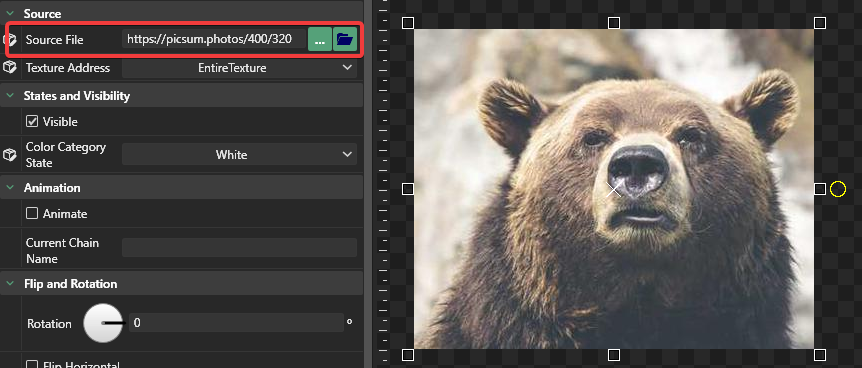
Sprites can also reference images without extensions, such as urls from <https://picsum.photos/>

<figure><img src="/files/bdSHJLPhnmnmeR1mUl9W" alt=""><figcaption><p>400x320 image referenced from Lorem Picsum</p></figcaption></figure>


---

# Agent Instructions
This documentation is published with GitBook. GitBook is the documentation platform designed so that both humans and AI agents can read, navigate, and reason over technical content effectively. Learn more at gitbook.com.

## Querying This Documentation
If you need additional information that is not directly available in this page, you can query the documentation dynamically by asking a question.

Perform an HTTP GET request on the current page URL with the `ask` query parameter, and the optional `goal` query parameter:

```
GET https://docs.flatredball.com/gum/gum-tool/gum-elements/sprite/source-file.md?ask=<question>&goal=<endgoal>
```

`ask` is the immediate question: it should be specific, self-contained, and written in natural language.
`goal` is optional and describes the broader end goal you are ultimately trying to accomplish on behalf of the user. GitBook uses it to tailor the answer towards what is most useful for that goal.

The response will contain a direct answer to the question and relevant excerpts and sources from the documentation.

Use this mechanism when the answer is not explicitly present in the current page, you need clarification or additional context, or you want to retrieve related documentation sections.