> For the complete documentation index, see [llms.txt](https://docs.flatredball.com/gum/llms.txt). Markdown versions of documentation pages are available by appending `.md` to page URLs; this page is available as [Markdown](https://docs.flatredball.com/gum/gum-tool/gum-elements/behaviors/default-implementation.md).
# Default Implementation
### Introduction
The Default Implementation property can be used to indicate which component is the default implementation for a behavior. This property is not used by the Gum tool, but instead exists for runtime implementations (such as FlatRedBall) to decide which type of component to create when an instance of a behavior is requested.
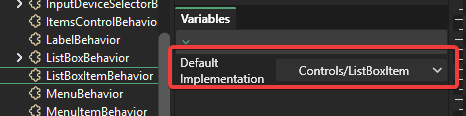
ListBoxItemBehavior with a Default Implementation set to Controls/ListBoxItem
{% hint style="info" %}
As of July 27, 2025 this property is used in the following runtimes:
* FlatRedBall
* MonoGame/Kni/FNA
* raylib
* Silk.NET
Additional runtimes may add support for this property in the future. If you need it for your project please make a request on GitHub or Discord.
{% endhint %}
### Common Usage
Behaviors are often used to help with the creation of components which need to have a certain set of states and instances. For example, the Button type in Gum Forms is associated with the ButtonBehavior.
At runtime, a game may need to create an instance of the Button type without specifying a component. For example, the following code can be used to create a button:
```csharp
var button = new Button();
button.Text = "Hello";
StackLayoutInstance.AddChild(button);
```
The Default Implementation property can help runtime libraries determine which component to create for the Button's visual.
The Button type is a good example of why this property might be needed because the default Forms components include multiple components which use ButtonBehavior.
Multiple button components
To resolve this ambiguity, the ButtonBehavior's Default Implementation is automatically set to Controls/ButtonStandard.
ButtonBehavior using ButtonStandard as the Default Implementation
For more information about whether you should set the Default Implementation, refer to the documentation for your particular runtime.
If you have created a custom runtime, such as a new ListBoxItem, you may need to change the Default Implementation for the ListBoxItem behavior.
---
# Agent Instructions
This documentation is published with GitBook. GitBook is the documentation platform designed so that both humans and AI agents can read, navigate, and reason over technical content effectively. Learn more at gitbook.com.
## Querying This Documentation
If you need additional information that is not directly available in this page, you can query the documentation dynamically by asking a question.
Perform an HTTP GET request on the current page URL with the `ask` query parameter, and the optional `goal` query parameter:
```
GET https://docs.flatredball.com/gum/gum-tool/gum-elements/behaviors/default-implementation.md?ask=&goal=
```
`ask` is the immediate question: it should be specific, self-contained, and written in natural language.
`goal` is optional and describes the broader end goal you are ultimately trying to accomplish on behalf of the user. GitBook uses it to tailor the answer towards what is most useful for that goal.
The response will contain a direct answer to the question and relevant excerpts and sources from the documentation.
Use this mechanism when the answer is not explicitly present in the current page, you need clarification or additional context, or you want to retrieve related documentation sections.
%20(1)%20(1).png?alt=media)
%20(1)%20(1)%20(1)%20(1)%20(1)%20(1)%20(1)%20(1)%20(1)%20(1)%20(1)%20(1)%20(1)%20(1)%20(1)%20(1).png?alt=media)