> For the complete documentation index, see [llms.txt](https://docs.flatredball.com/gum/llms.txt). Markdown versions of documentation pages are available by appending `.md` to page URLs; this page is available as [Markdown](https://docs.flatredball.com/gum/gum-tool/gum-elements/container/contained-type.md). Agents can also search and read this documentation through its [MCP server](https://docs.flatredball.com/gum/~gitbook/mcp).
# Contained Type
### Introduction
Contained Type enables code generation and Gum runtimes (such as FlatRedBall) to create strongly-typed containers.
{% hint style="info" %}
Currently the Contained Type variable does not have any affect on objects in the Gum tool and it exists only to support strongly-typed runtimes. This may change in future versions of the Gum tool.
{% endhint %}
### Common Usage
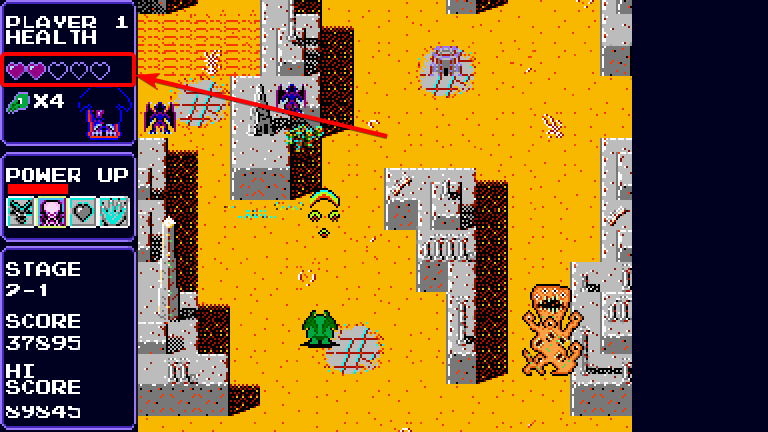
Some Gum components or Containers may exist to hold a list of a particular type of item. For example, consider a game which includes a row of hearts to show the player's current health.
Row of hearts displaying the player's health
In this particular case, the hearts can be filled or empty to show the current and max health, but the max health can also be increased. If the max health increases, then a new heart instance is added to the container at runtime.
Since this container should only ever contain instances of a Heart component, then the container's Contained Type can be set to Heart.
HealthContainer instance with its Contained Type set to Heart
In this example, FlatRedBall respects the Contained Type variable and generates a generic list.
ContainerRuntime can be generic in FlatRedBall, so it respects the Contained Type variable
As mentioned above, the implementation of this variable depends on the runtime you are using. If you are using a runtime which does not implement this feature and you would like to have it added, please create a GitHub issue or make a request in Discord.
---
# Agent Instructions
This documentation is published with GitBook. GitBook is the documentation platform designed so that both humans and AI agents can read, navigate, and reason over technical content effectively. Learn more at gitbook.com.
## Querying This Documentation
If you need additional information that is not directly available in this page, you can query the documentation by asking a question.
Perform an HTTP GET request on the following URL with the `ask` and `goal` query parameters:
```
GET https://docs.flatredball.com/gum/gum-tool/gum-elements/container/contained-type.md?ask=&goal=
```
`ask` is the immediate question: it should be specific, self-contained, and written in natural language.
`goal` is what the user is ultimately trying to achieve, the reason they need the answer. Sharing it helps GitBook give you a better, more relevant answer. A goal is most helpful when it describes the outcome the user wants rather than restating the question. For example, with `ask=how do I create an API token`, a goal like `automate deployments from our CI pipeline` lets GitBook tailor the answer to that use case.
The response will contain a direct answer to the question and relevant excerpts and sources from the documentation.
Use this mechanism when the answer is not explicitly present in the current page, you need clarification or additional context, or you want to retrieve related documentation sections.