> For the complete documentation index, see [llms.txt](https://docs.flatredball.com/gum/llms.txt). Markdown versions of documentation pages are available by appending `.md` to page URLs; this page is available as [Markdown](https://docs.flatredball.com/gum/gum-tool/tutorials-and-examples/animation-tutorials/creating-an-animation.md).
# 2 - Creating an Animation
## Introduction
This article shows how to create an animated component. It will contain an animation which can be used when the component first appears.
## Creating the Component
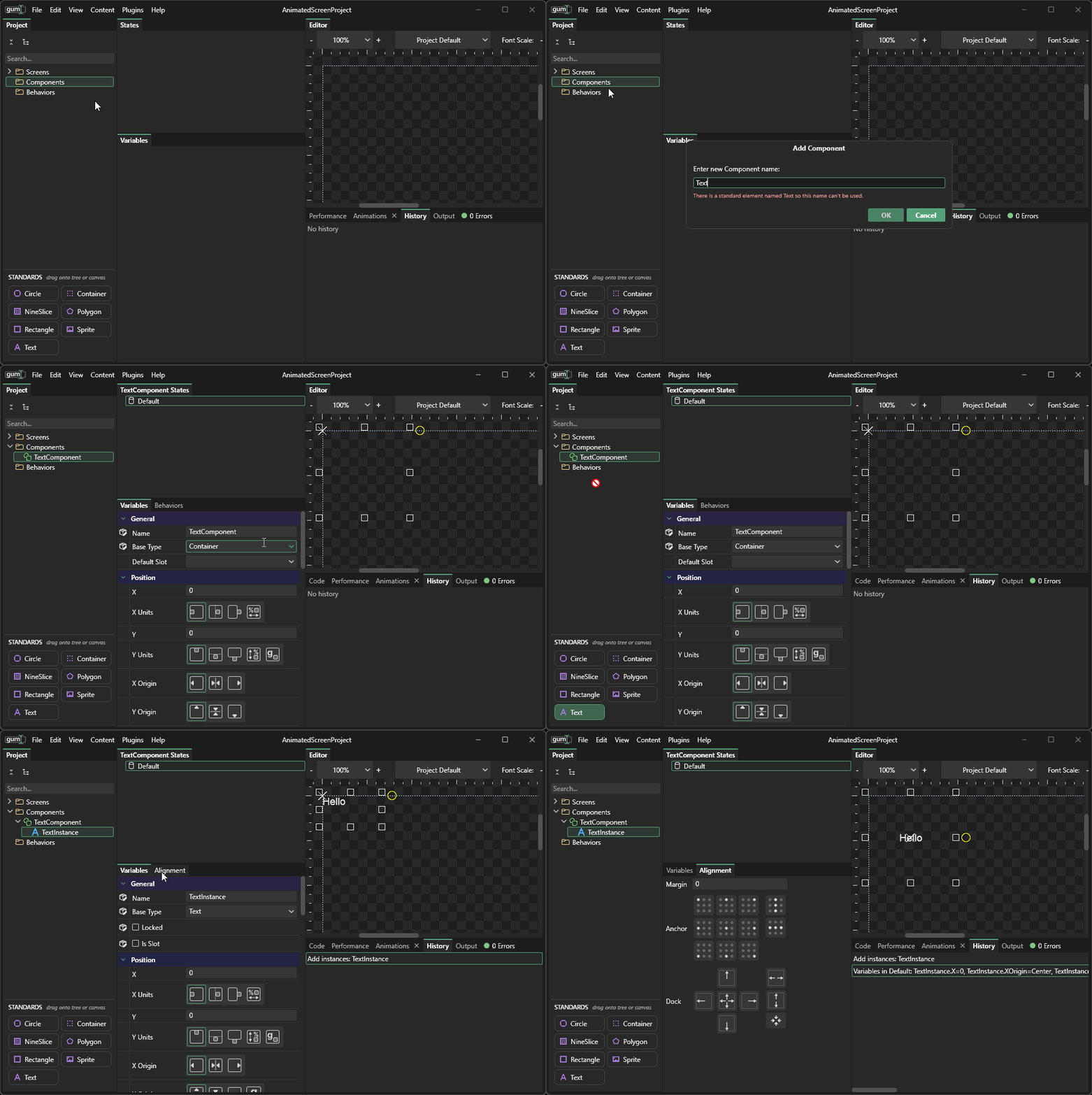
First we'll create a component which will be animated. To do this:
1. Right-click on **Components**
2. Select **Add Component**
3. Enter the name **TextComponent** and click OK
4. Drag+drop the **Text** Standard into the **TextComponent** to create a Text instance
5. Select the **Alignment** tab and click the middle button to have the TextInstance fill the TextComponent
## Creating the States
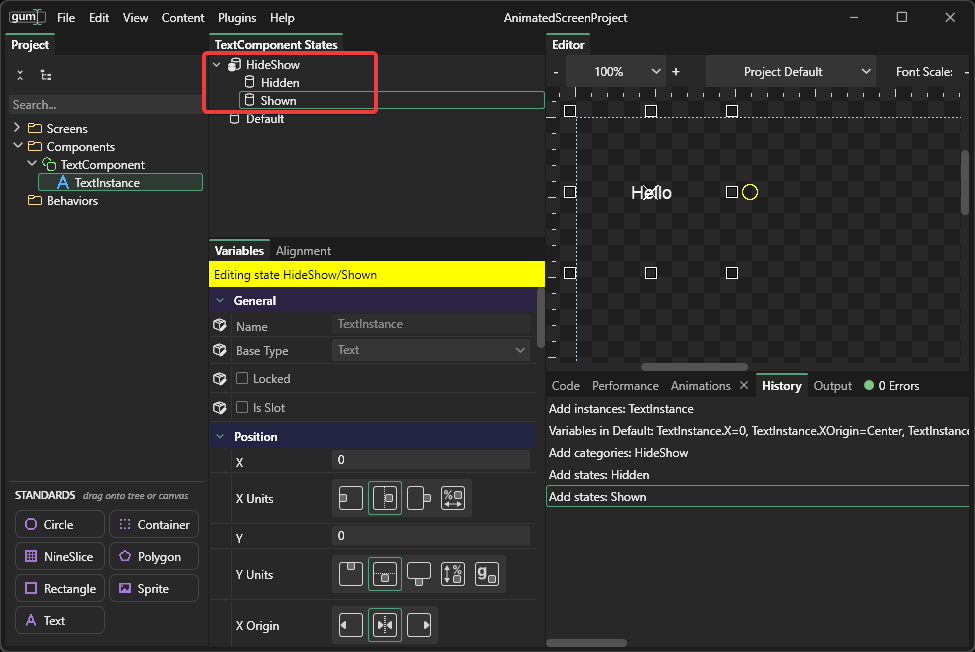
Now that we have a component we'll add the states needed for animation. We'll add all states in a category called HideShow. Animation states should always be categorized. To create the states:
1. Right click in the States list box
2. Select **Add Category**
3. Enter the name **HideShow**
4. Right-click on the **HideShow** folder
5. Select **Add State**
6. Enter the name **Hidden** and click OK
7. Right-click on the **HideShow** folder
8. Select **Add State**
9. Select **Shown**
## Setting values in the states
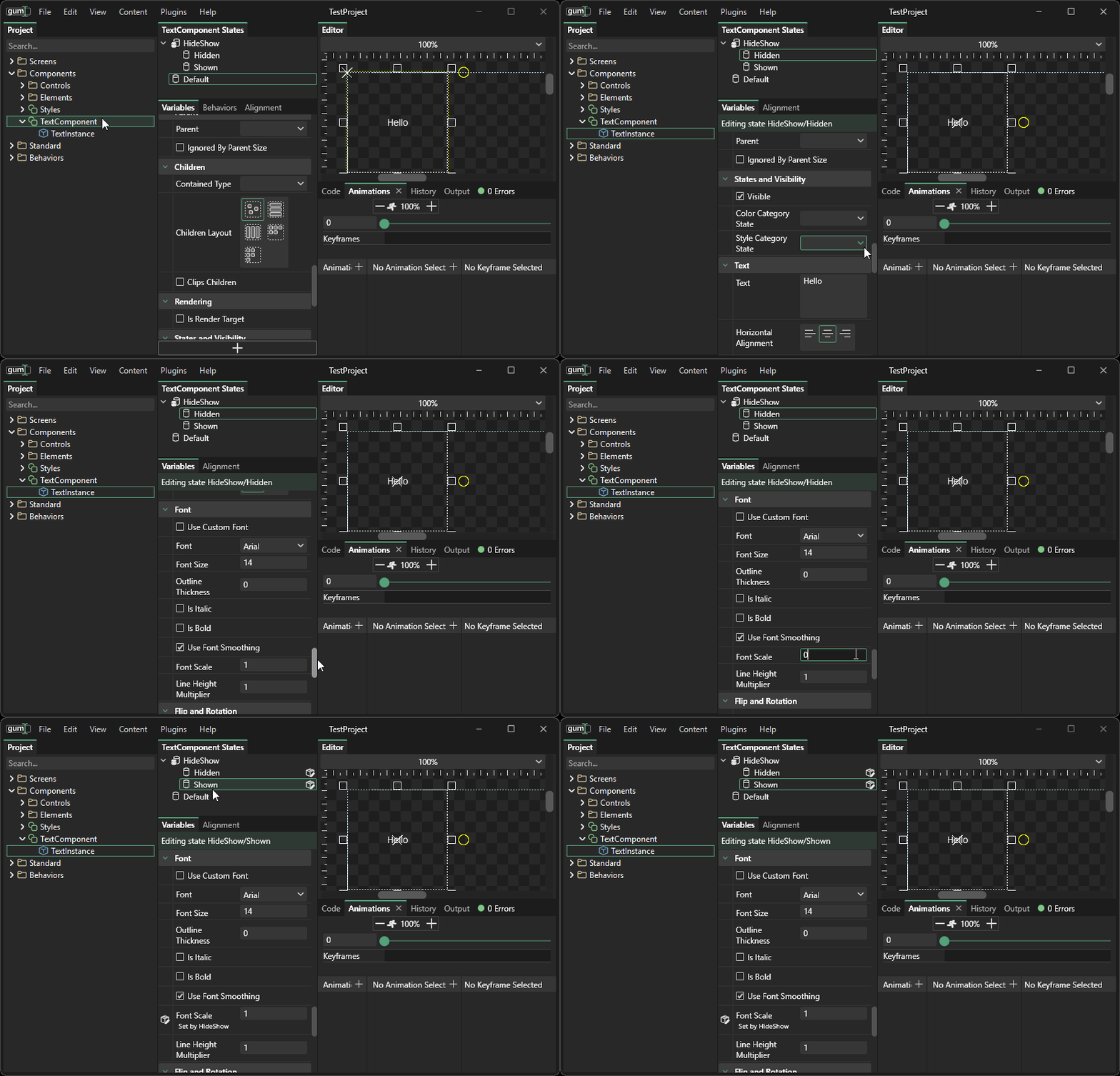
Now that we have the states defined we can set values for the states. In this case the only thing we'll be modifying is the TextInstance's **Font Scale** value. To do this:
1. Select **TextInstance**
2. Select the **Hidden** state
3. Set the **Font Scale** to 0. This makes the Text so small that it's invisible
4. Select the **Shown** state
5. Verify the **Font Scale** is 1, or set it to 1 if not. This makes the Text regular size
## Creating the Show animation
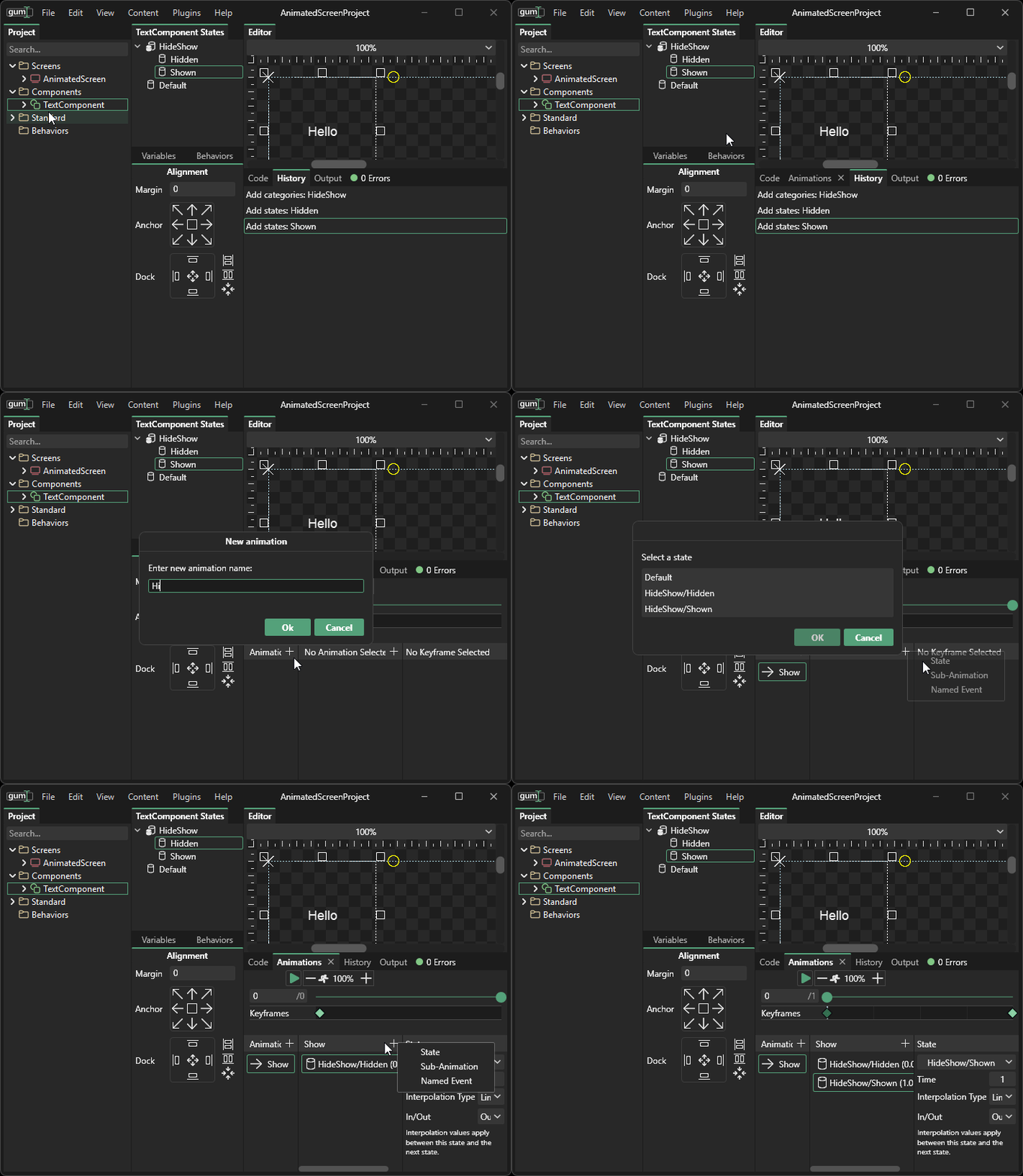
The two states we created above will be used as the keyframes for our animation. The animation will begin in the Hidden state then interpolate to the Shown state. To add this animation:
1. Verify that **TextComponent** or any objects under it are selected
2. Select **View** -> **View Animations**
3. The **Animations tab** appears in the bottom right
4. Click the **Add Animation** button
5. Name the animation **Show** and click **OK**
6. Select the Show animation and click **Add State**
7. Select the **Hidden** state and click **OK** - this is the first keyframe in our animation
8. Click **Add State** again
9. Select **Shown** and click **OK**
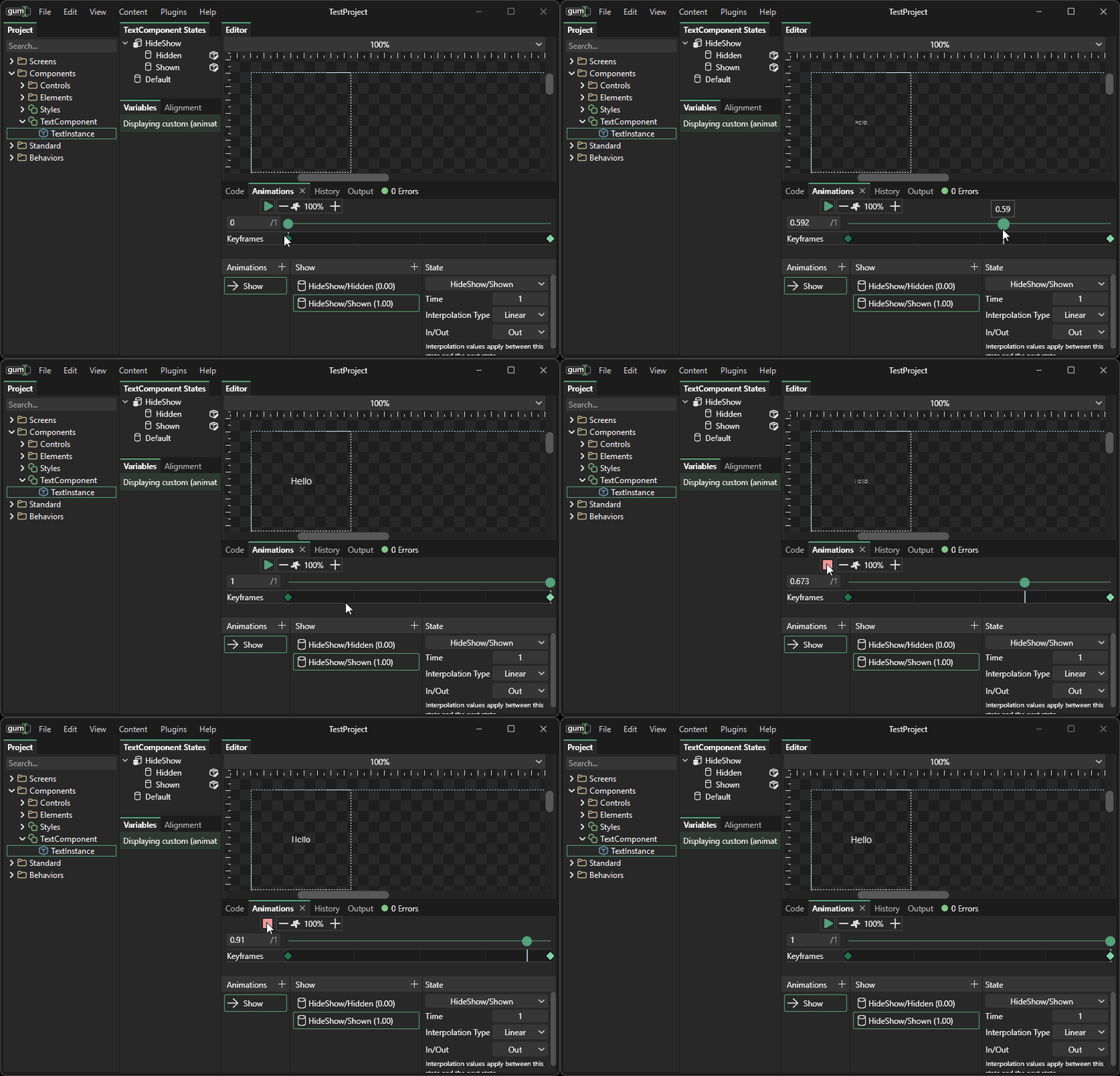
The animation can now be played or previewed:
## Adjusting Interpolation Type
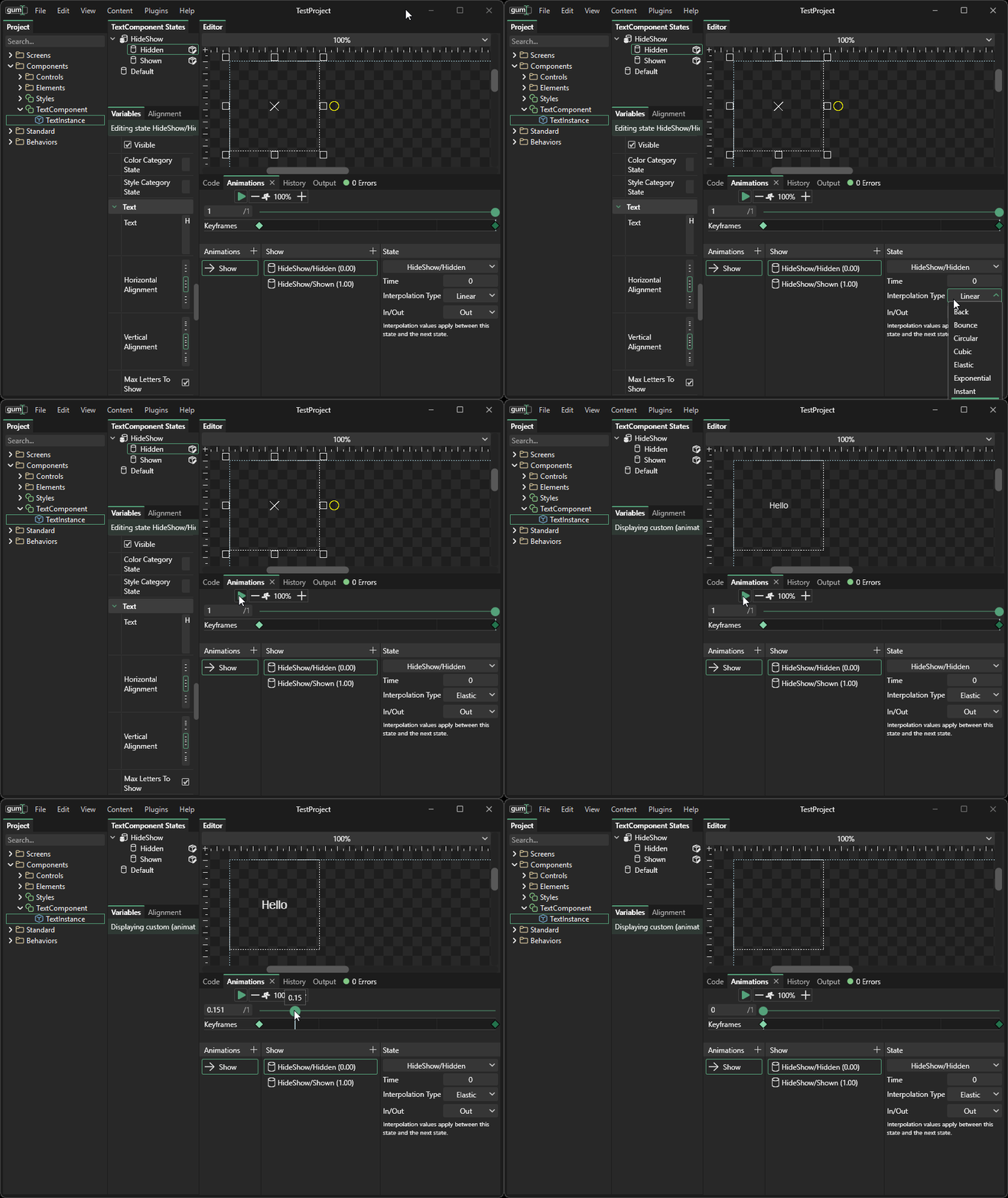
The **Interpolation Type** value sets how one keyframe blends to another. By default keyframes use **Linear** interpolation, which is a constant change from one state to another. When interpolating from one keyframe to another, the first keframe defines the interpolation type. In our case the **Hidden** frame defines the interpolation type. We can change the Interpolation Type and preview the animation:
1. Select the **Hidden** keyframe
2. Change **Interpolation Type** to **Elastic**
Playing the animation will reflect these changes.
---
# Agent Instructions
This documentation is published with GitBook. GitBook is the documentation platform designed so that both humans and AI agents can read, navigate, and reason over technical content effectively. Learn more at gitbook.com.
## Querying This Documentation
If you need additional information that is not directly available in this page, you can query the documentation dynamically by asking a question.
Perform an HTTP GET request on the current page URL with the `ask` query parameter, and the optional `goal` query parameter:
```
GET https://docs.flatredball.com/gum/gum-tool/tutorials-and-examples/animation-tutorials/creating-an-animation.md?ask=&goal=
```
`ask` is the immediate question: it should be specific, self-contained, and written in natural language.
`goal` is optional and describes the broader end goal you are ultimately trying to accomplish on behalf of the user. GitBook uses it to tailor the answer towards what is most useful for that goal.
The response will contain a direct answer to the question and relevant excerpts and sources from the documentation.
Use this mechanism when the answer is not explicitly present in the current page, you need clarification or additional context, or you want to retrieve related documentation sections.